Note" 2026-Oct-16 On the Russian-American Andrei Martyanov commentary on Critical Thinking & can it actually be taught or must it be done R0
Note: 2026-Oct-15, Thursday I have posted my most recent chat with Google AI Mode (a 100% Free AI Chat service. But again, until I have time to create the various topic folders (in html5 format) I have to go with this sort of a, is it "Blog" ? Well anyway, the chat is in pdf portable form which means it is copyable and pastable. One credit of recognition I need to give. On most of my chats with Google Gemini (subscription, not very $, which I use mainly for highly technical topics where I want to be able to save and tie in with other related research which I can do with Gemini and other such conveniences) and chats with Google AI Mode and its other variations all of which are free and China's Chat.Deepseek.com which is also free. And that recognition goes to Ray McGovern , A B C D etc. former Branch Chief of the Soviet Union Analytical Branch; former chairman of National Intelligence Estimates under Pres. Reagan; and a personal friend of George H.W. Bush, former CIA Director who later on achieved the rank of President. And it is for his emphasis on several interviews with the Danny Haiphong Network of the почему (pronounced pah-chee-MOO).
Here is a visual to help you, because, well it is Russian. pah-chee-MOO . I am working on translating the American Moo cow sound into the Russian moo cow sound. I get no help from Ray, but I am not a quitter. I Was a quitter only once, but never again - not in 66 years. Until my last days I shall keep at it until at least I get the distinct Russian accept of their cow's Moo.
Once again it is late. Because McArthur did it - so shall I return. But if you do want to read this extemporaneous chat (I prefer to think of it as one more Free Association talking cure with my childhood therapist of long long ago. I suggest you start of page 6 (before that the writing is going to make no sense to those of you who fall within (+/- 1 sigma) standard deviation, i.e., 68% of you on the IQ Judgement Bar. That's me. I prefer to be average. That way not so much is expected of me - giving me more time for myself to day dream.
Click on the link diretly below in blue color. On upper right to of your screen (depending on your viewing device) a small square box with arrow pointing up and due east - click on this and the pdf will open up and you can scroll the entire 11 pages in one smooth operation. You will be able to copy and paste whatever you want and download if that is your wish. I use Kofax Power PDF and have done so many many years. They were bought out by someone(common event in USA - the big money is made by buying and selling companies and hoping you make the right bet and sell your shares at the right time. That doesn't really allow for long-term quality improvements does it? No more real passenger trains throughout the country anymore. Say porter, where did you go? No more bus servcie to speak of anymore. Bought out to EXTRACT VALUE and sell off the bus terminals for the hedge fund. Let's see. Planes? Perhaps the DC-3s are still working, can land them in the corn fields if necessary. Looking ahead I decided to get me a good fast quarter horse with them still attached. Makes them more frisky, you know. Figured I could make better use of my 3-car garage. Just to play it safe, I thought I better check with "The City." You want to do what! That idea was out.
Rented me a stall for my horse Blacky at a farm about 6 miles away. I thought then, well I'll get me some chick Rode Island Reds and a few Domineques. Raise me the males 'till they was pullets and then eat 'em. The hens, when they get to laying I'll feed em protein rich mixtures from the Farm Feed Supply store. Expensive, sure, but that eggs a deep deep orange and doesn't splatter all over the frying pan even if ya crack that shell 8 inches (converted to metric upon request) above the pan. Try that one with your "Organic" free to roam (and I won't tell you want they eat beside the worms and a grub now and then. One last thing to say. If youse raisin them in a long rectangular barn, got the water set for gravity flow, there's still the thing about the floor. Dirt's good. Now you'll produce some good chicken xxxx but you gots to know its hot as hell. You go to mixing it with your geraniums (sp) or heaven help you if you put some in the pot of your wife's orchids. So its best frankly to mix a small amount with plenty of top soil (oh yes and I WOULD, if I be you, wear rubber gloves or even the latex ones will do. What did the city say? You do and we WILL condem the place. Understood? Yes sir I understood. (spelling corrections later)
2026-Oct-15 AI Mode chat on LaTeX markup & Atrophy of the Human Brain
G
Go to ---> Rousseau and the 1789 Declaration & The Early Marx New posting. The webpage was written and modified using Microsoft Notepad++ which is free and also an excellent editor for web programming in html or css or JQuery or JavaScript. Anyone in my opinion who has reached 7th grade level can learn much quicker than you might think - how to do "web coding." As for a computer? A used Xp and on up will work just fine. Thrift stores such as Teen-Challenge are filled with monitors. You do have to know fundamentals. But learning to walk means at first you take one step at a time. The key to absorbing new knowledge is to open yourself to having fun without worry about the consequences of failure. Because falling down is one of the steps you must take in order to learn HOW TO GET UP BY YOURSELF. And AI is the best tutor you can hope ever to have. If I had not been down this road myself, to teach yourself with the resources that are now available to you - I would not claim that you can do the same thing. More later as things develop.
Note: 2026-Oct-14,Wednesday. I have completed converting this website page over to the more recent format for web page coding, html5 & css3. This will make the writing and pictures more compatable for each of the major browsers. Also, in the same format, html5 I am going to put all commentary it its own folder which I title obiter dictum. Now I am not trying to be cute and certainly not use or imply to use sensitive words. Actually obiter dictum is a Latin word (Latin is a dead language but which is still used by Catholic priests and lawyers for serious type of words. It means in that language, Latin, "Oh by the way." You can open up the link (see above) and see what I mean. Why lawyers don't just speak in English and leave it at that - well if you didn't have something to hide would you be a lawyer? As for Catholic priests - most times the only time they use Latin is when telling another priest what you told them in confession. Well, it's a "dead language" so whose to know. Anyhow, you know that saying in politics, Never let a good story go to waste? You don't think priests are human too? OK. As long as its all kept in the family. Right.
I want to post my commentary to a youtube I watched this morning. I think this exposure to the truth will help you understand why the economy is crashing all around you. It is not your fault (blame first and most the Federal Reserve, the worlds biggest PRIVATE bank but poses as the Savior's bank to save mom and dad when the FED's "roll of the dice gambling on interest rates go sour and they don't have the money to pay off their bad bets and go sucking up to the government and people such as President Trump looking for a handout (and NO, the FED is not owned by either the Israeli lobby or the Democrats. The FED is OWNED by the other giant banks (they actually call themselves The Jolly Green Giants because they are usually bloated with printing press green dollars. But not this time. This time is gonna be you, Maw and Paw who is going to get stuck with the tab; and it won't be chitlins (correctly spelled Chitterlings) or Idaho white potatos ... (They're grown in volcano soil. Anyone for a Vesuvius spiced with chitlins? just asking you know.) ... you'll be eating. 'Cause you won't be able to afford them. Have you checked the green dumpster behind McDonalds lately. Rumor has it that they look the other way after midnight. A community service you know; civic responsibility. And who done all this to you?
Peter Thiel is what Marx Warned Us About! My commentary is a very rough extemporaneous polemic draft which is a polite word for rant. Most of President Trump's speeches are in the form of a rant as commentary. (See the link for accurate definition. It is not what his enemies try to project, insanity.). Google's Gemini AI . . . (a paid AI subscription. Google AI Mode is 100% Free as is Chat.DeepSeek.com . . . commentary which goes into serious explanations. This commentary is in pdf form because it would take quite a few days (life has other duties to do too.) and in this way, pdf, it gives me time to edit, revise etc. for my own desire not to turn out something mediocre as I never did with the few painting I did decades ago.
2026-Oct-14 HOMELESS OF THE WORLD UNITE! YOU HAVE NOTHING TO LOSE BUT YOUR LIFE. YOU HAVE A POLITICAL SYSTEM TO CHANGE
2026-Oct-11 Note on Trumpitis. I am adding links to many of the terms that people are not familiar with such as "demenor of normality. Götterdämmerung in the context of Hitler when he decided to destroy Germany because "the German people had FAILED HIM! Had not been Arian enough. By itself, Götterdämmerung on a search engine would lead you (one) to the Vugnarian (my phonetic interpretation for German name Wagner - who as I remember it - was once the mayor of New York City. At any rate, the guy, Trump is phycho at times but then again completely coherant at others. If you look at his old The Apprentice series (which are still available from shops in Peking one of which is called Shop Peking) you see a complete flip in the person Trump. Charming, very intelligent, quick responses, etc. And yet he does not break into word salad nor to me any sort of schizophrenic behavior. By the way, these xxx-holes who make claim to being the only ones who can "judge" whether a person is a nut-job or not - can stick it in the same place, Op. cit. Is Trump now psychopathic in the Freudian sense? It depends so much on the context in which you are placing him in that diagnosis. For instance. Was FDR blind or indifferent to the slaughter of the jews in the concentration camps, most of which were in Poland? Especially when near to the end of the war evidence was brought to him substantiating this fact, the murder of which (really knows the true count?) and why is the same atrocity committed on captured Soviet military at this same time which was in the millions - sort of "forgotten" in the West. The main argument was that FDR should "approve" the aerial (up in the sky) bombing of the various camps to allow the victims to escape. Both Gen. Marshall and Gen. Eisenhower disagreed. In short, they believed that the situation would be made worse, and actually hasten the victims extermination. If you read these arguments, a thing which with AI now you can do without having to buy a load of books, their logic is sound. One really sad event was Voyage of the Damned of which both the book and the movie tell a sad event and how unhuman humans can be. Another reference which gives a harsh view with respect to USA response. I have this book and this true story is one that is hard to accept. But with AI you can research the OTHER REASONS for the decisions that were made. Thngs are never easy to understand in the political world of reality. In concluding for now I can only say - I no longer know what is true from what is false - and the internet seems only to make matters more ambiguous. In terms of the overall picture, the panoramic view - it seems to me that Trump IS moving int he right direction and getting us out of the NATO mess, as well as pulling us free of Israel. But only time will bring the picture clearer. End for now.
Warning to the World
Trumpitis is Fast Spreading
To the Whole World
Masks will do no good!
What is the Freudian view of the phychopathic personality? AI Overview please: This link also explains why, in the Freudian view, there is no "cure" for the psychopath. The Freudian view is that the underling problem is a structural defect of the psyche (which "houses" the brain) , primarily characterized by a severely underdeveloped or completely absent superego. The superego is Freud's CONSTRUCT (a tool that he uses to CONSTRUCT HIS THEORIES THAT FORM THE PSYCHOANANYTIC SCHOOL OF PSYCHOTHERAPY. In its day, late 1890s with his publication of The Interpretation of Dreams, 1899 until Herr Doktar Seagram Freud fled Vienna on June 4, 1938, following the Nazi annexation of Austria (the Anschluss) with the Gestapo hot on his tail - to Great Britain, then the bastion of freedom of speech as it was {this bastion of free speech) for Karl Marx who was also forced to flee first Germany (the Kingdoms at that time) then France and finally to safety and a home in the famed British Library where he, Karl Marx, spent much of his mid-years in study and research in developing his version of The Rights of the Working Man.
Yes, this polemic is some what off-key from the above discussion of the a-moral (lack of any morals) psychopathic personality. But as Stravinsky often played discordant notes,let us press on.
Question to Google Gemini AI (a subscription service) https://gemini.google.com/app/1547e3c358e8f588
Question to Google Gemini AI : Is it a fair comparison for me to say: that as Rosseau's Declaration of the Rights of Man and of the Citizen was a defense of the rights of the common man (as the British identify those not of the Royal Blood, the working man, so too Marx's work was likewise a defense of the working man in a time when the "ordinary working person" was subjected to exploitation for the main purpose of maximizing profits from that exploitation for an elite few, the Capitalist rulers who controlled the means of survival, being the means of production at that time, 1848 period and also now in many quarter of the world today, the 21st Century.
Your comparison captures an important thematic continuity: both Jean-Jacques Rousseau's political philosophy (which heavily influenced the 1789 Declaration of the Rights of Man and of the Citizen) and Karl Marx's early writings were motivated by the subjection, alienation, and disenfranchisement of the broad masses by a privileged elite.
However, in political theory and intellectual history, calling Marx's work—especially his early writing—a defense of the "Rights of the Working Man" creates a profound philosophical paradox.
A closer look reveals both historical corrections and key philosophical tensions in this comparison.
1. Historical Nuance: Who Wrote the Declaration? Jean-Jacques Rousseau did not draft the Declaration of the Rights of Man and of the Citizen. He died in 1778, eleven years before the French Revolution. The 1789 Declaration was primarily drafted by the Marquis de Lafayette, in consultation with Thomas Jefferson, and adopted by France's National Constituent Assembly.
Rousseau's ideas (The Social Contract, popular sovereignty, the "general will") deeply permeated the document's spirit, but the Declaration itself codified classical liberal bourgeois rights: private property, individual liberty, and equality before the law.
2. Where the Comparison Holds: Moral Outrage and Human Dignity Your comparison holds genuine merit when viewed through the lens of human emancipation:
Resistance to Structural Domination: Just as the French revolutionaries and Rousseau rejected the divine right of kings, feudal privilege, and aristocratic monopoly, Marx's early writings (particularly the Economic and Philosophic Manuscripts of 1844 and The Holy Family) attacked the reduction of the worker to a mere commodity.
The Critique of Exploitation: Marx saw that the Industrial Revolution had replaced legal servitude with economic coercion. If an elite controls the means of production, the "free" worker has only one real choice: sell their labor power or starve. In that descriptive sense, Marx's enterprise was indisputably dedicated to liberating the working class.
3. The Core Tension: Marx's Critique of "Rights" The crucial analytical distinction is that Marx was fundamentally skeptical of the concept of "rights" (Menschenrechte).
In his landmark 1843 essay, On the Jewish Question (Zur Judenfrage), Marx directly analyzed the 1789 Declaration of the Rights of Man and of the Citizen:
Rights as Bourgeois Isolation: Marx argued that the "so-called rights of man" were simply the rights of the egoistic individual, separated from community. To Marx, liberal rights (liberty, equality, property, security) treated man as an isolated monad and legitimized private property—the very mechanism enabling capitalist exploitation.
Political Emancipation vs. Human Emancipation: Marx contended that the French Declaration achieved political emancipation (citizens are nominally equal under the law), but failed to achieve human emancipation. A factory worker and a factory owner both have the legal "right" to own property and speak freely, but their material realities remain vastly unequal.
Rights as an Ideological Mask: Marx viewed rights discourse as bourgeois ideology (Rechtsideologie). Framing struggles in terms of abstract "rights" implies that fair laws within capitalism can solve the problem. Marx argued instead that capitalism's contradictions cannot be reformed through rights jurisprudence; they require the abolition of private ownership of the means of production.
note: 2026-Oct-12 12:40 am what follows needs to be put into table form - which I prefer. Soon. I am doing catchup on this webcode stuff and I think the best way to learn is by doing something real. If you screw up it affects your limbic system unless your the typical legislator, emotionally flat, and the emotion causes you to better remember as there are more associations when you are actively involved in a problem than learning the way it is taught in an American public school.
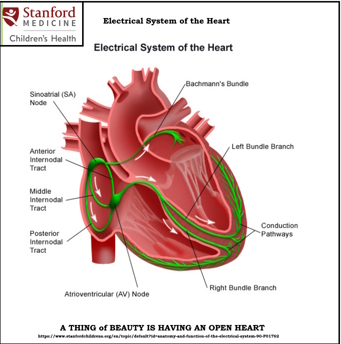
As an example, I'd rather learn about the heart doing a disection on the real thing (though naturally dead) than these rubbery models. Working with the artificial is just that, artificial, which is much of what America has become in terms of the relationships between people. It seems increasingly that people are becoming disconnected from each other. As for example, how often when you call up some business an AI answers. My attitude is that if a business cares that little about their customer - then hell with them, I am not going to do business with them.
Locally here the hospital no longer calls a day or two in advance reminding the patient that they have an appointment coming up. And if you forget, and at 81 I do, then you get a letter reminding you that you have two unapproved cancellations left before you are dropped as a patient. I now go to an Urgent Care that does not accept insurance cards and requires full pay upon service. If the hospital is so focused on profits above all else, which by their actions they are, then I as a human being am being discounted by them. And it is worth it for you to read the link.
And we are being discounted, minimized. And the jackels in Houston tell the hospital CEO, "Listen Chum, you can increase your profits and your 5 year bonus by firing the ladies that make all those reminder calls. It's the patients responsibility to remember when an appointment is coming up. Get rid of those woman, they're excess baggage. Remember what our Prophet Sri Milton Friedman said, "Screw the customers, your only obligation is to your stock holders and you, the CEO."
I remember when Milton Friedman. an "economist" who won the Noble Prize for being full of gas, The Big Fart was his other name, said in about 1969-70 that the corporation was only obligated to the share holders (stock holders). Which when translated into Common Man speak said We the Corporations of America don't give a flying f___ about you, the Little People (remember Leona Helmsly - who gave her billions of $$$ to her little pussy friends (her cats) rather than to some decent cause that might have helped the "little people" which both she and Milton Friedman despised as does your corporate America despise you.
Who sold the American worker down the sewer tubes and moved manufacturing to China because it was more profitable for them and their share holders (stock holders). And your government did nothing to stop the mass flow of jobs out of the USA. Even the mulatto president, O'boom-boom betrayed his American negro half and his Sand negro half down the tubes for the white man's money. Because the truth be accepted though hard to do - both parties, republican and democrats don't give a rats-ass about the American people's votes. They serve the Israeli lobby first and the American people last.
These senator and for sure many of the congressmen care only about their DONORS - who keep these parasites employed in government, both at the presidental level and those freshman senators whose main function when the senate is in session is to clean the chamber pots for the senate leaders, majority and minority, and the chairmen of the various committees. Becasue, once again, let the truth be known, no legitimate American corporation would hire them because in the competitive world - all that most of these senator but fewer of the congressmen have to offer an employer is big mouths blowing out gusts of inert gas (does nothing but float up into the sky) gas (the noble gas prize given to Friedman.) What an honor, what an honor that must be.
What you see now, Oct. 2026, is a collapsing American economy. And it will not reverse. Because as in China with the young " lying flat "
2:20 am. Later than you think. 73s and OUT. But I shall return.
Summary Comparison
Dimension Rousseau & The 1789 Declaration Early Karl Marx (1843–1848)
Primary Target Feudal monarchy, aristocratic privilege, hereditary rule Industrial capitalism, wage labor, private ownership
Concept of "Rights" Universal, natural, inalienable moral claims Historically contingent, bourgeois ideological constructs
Ideal Outcome A constitutional republic of equal citizens (Citoyens) A classless communist society abolishing wage labor
Nature of Freedom Freedom under the rule of law and the general will Overcoming alienation (Entfremdung) through material control
The Verdict
Colloquially and morally, yes: Marx was the foremost defender and advocate of the working class against exploitation by capital.
Philosophically, Marx would firmly resist having his project described as defending "The Rights of Man." He sought not to grant the worker better abstract rights within civil society, but to transcend civil society and the framework of legal rights altogether through the material emancipation of labor.
If you would like to explore this philosophical transition further:
Explain Marx's four types of alienation in the 1844 Economic and Philosophic Manuscripts and how they relate to the concept of rights.
https://gemini.google.com/app/1547e3c358e8f588 /
Question to AI Mode (AI Mode is Google's 100% free service, similar to Chat.DeepSeek.com which is offered free to the world in most of its languages for purpose of promoting education for all.
I have over three years now hundreds of pages of AI directed tutorials dealing with the heart as an engine. I chose a topic of which I knew nothing, biology. And having essentially no formal highschool education as such I used AI as my personal tutor. In similar manner I have used this new teaching tool, AI, to better understand aspect in electrical field theory which when I took this course in my final year at university, essentially Maxwell's four Equations - I felt then and now, many decades later, that class in electromagnetic theory to be a perfect perfunctory experience. The experience was the same to me as the person who is ordered by his Sgt. Major to push a heavy stone ball up a long hill and then to watch it roll back down and to do so until I had come to understand what gravity was all about. I learned from my marine friend and Vietnam combat veteran that in the marine corps they call such classes - motivation.
It is now 9pm CST 2026-Oct-11 and I am going to take a break and see what is happening with the war in Iran; and to make me some spagetti now that the harvest is complete and the spagetti strands have been picked clean from these trees grown only in Israel.
: Is it a fair comparison for me to say: that as Rosseau's Declaration of the Rights of Man and of the Citizen was a defense of the rights of the common man (as the British identify those not of the Royal Blood, the working man, so too Marx's work was likewise a defense of the working man in a time when the "ordinary working person" was subjected to exploitation for the main purpose of maximizing profits from that exploitation for an elite few, the Capitalist rulers who controlled the means of survival, being the means of production at that time, 1848 period and also now in many quarter of the world today, the 21st Century.
What is Götterdämmerung in terms of Hitler's demand for totatal destruction of Germany when defeat became inevitable & Herr Hitler could not longer be self-deceived?
This is important in order to understand what you are truly dealing with in a Herr Trump type person and his type because of their (this type of person) typical actions, their behavior when the fog of self-deception (the curtain of reality begins to rise and behold, the little man and his thunder his just an act to deceive you, and in this case, the American people. - i.e., his self-deception. Because this (his self-deception) marks him - explains how he can live in his own world yet project a demenor of normality.
1] When prefixed to sexual activity, it highlights that sexual feelings, responses, and identities are deeply tied to or driven by mental and emotional processes rather than just physical mechanics.
2] Mental and Emotional Attitudes: It describes how a person's thoughts,fantasies, and emotional blocks shape their view or experience of sexual activity.
What Trump wants to inflict -- on the USA and infact -- on the World (does he not show his hate for all of USA allies, I mean Canada, not just Russia and China – but the World is his own brand of Götterdämmerung = [Twilight of the Gods – Herr Hitler's favorite movement by Wagner (pronounced vug_na] (German word!}
And what did Herr Hitler do - when he realized that he was BEATEN, defeated. I mean preceeding his glorious suicide. Hitler ordered the total destruction of all German infrastructure, from bridges to water treatment facilities. All infrastructure. [Does that "ring a bell?"] What does Trump keep emphasising and wanting to do to first - Iran, then whose next?
And Hitler orderd his fellow architect and friend, Albert Speer who served as Hitler's Reich Minister of Armaments and War Production to do the job. But for Albert Speer's decency and love of Germany - the nation of Germany would have been totally destroyed and millions of its innocent citizens would have perished.
Who is demanding and doing the very same thing that Hitler did to Germany? Not yet to destruction but yes to destroying long time relationships with trusted allies. And who is NOT restraining him? And why now a Department of War! Does that not tell you the INTENTION of Trump and his troupe? Thus this alone tells you what this countries leaders controlled by THEIR LEADER have become ----> Beware the Devil Satan when he is in your house.
And Satan IS running wild in the house of the United States Republic. Trump's ambition is to GO OUT in his version of a blaze in glory. THINK IT THROUGH - WHAT IS THIS DERANGED PSYCHOPATH DOING TO THE UNITED STATES. He is NOT preserving anything; he is NOT protecting and he sure isn't seeing that the laws of the nation are upheld! Then just what is he and he selected followers doing? GÖTTERDÄMMERUNG!,/p>
The meaning of GÖTTERDÄMMERUNG is a collapse (as of a society or regime) marked by catastrophic violence and disorder; broadly speaking, the downfall of a nation. Trump's actions are illogical because he is demented. Think, think: Trump has systematically destroyed the economy of the USA, Germany, Britain, and it is spreading world-wide.
Trump carries revenge-hatred in his heart. Does it matter the why? Isn't it more urgent that he be stopped before he provokes and initiates a world wide war with Russia , China and many others?
Tonight a friend of mine in LA said that diesel fuel was hitting $10. Gallon if you could find it.
Collapse collapse - that is what is Trump's heart beats to, collapse and destruction of eveything. His is fanatic revenge at everything.
Act before it is too late.
Note: Everything I have written above is my personal opinion. Therefore it should not be taken seriously. You sleep well tonight and the nights to come. I am expessioning myself in an Egar Allen Poe format but I am also asserting my Constitutional Rights under the Bill of Rights, 1st. Amendment as a community service. Let us hope that the Constitution and Bill of Rights is preserved. 73s & End Chat.
Note 2026-09-27 Posting of first self-tutoring tutorial on the-cardiac-engine.net Subject, Wendy Riggs Lectures on Action potentials in biology, covering on youtube.com the following: 1]NS cells, 2]Neuron 3]electricity 4] NA+ K+ Pump 5]resting membrane potential 6]The Action Potential 7] Steps 8] Refractory periods. End list//
Wendy Riggs [ https://www.youtube.com/@wendy-riggs ] teaches Anatomy, Physiology and General Biology in a " flipped " classroom. AI Overview : A flipped classroom is a teaching method where students learn new material at home and do problem-solving and projects during class time. How it works. How It Works: At Home: Students watch recorded video lectures, listen to podcasts, or read materials before the lesson. How it works In Class: Students use class time for discussions, hands-on activities, and group work with the teacher's help. End AI Overview.
Because [ https://the-cardiac-engine.net] is a devloping, and I hope, work of art - it will come in stages. The first is to "re-learn" website coding, html-css after years away to go after other intersts, then to learn the basics of cardiology anatomy and a bit here and there of biology. That has been two plus years. A primary source for detailed explanations was, until AI became available to the common generic man I used Google's search engines. Then when China gave to the world free, DeepSeek.com everything changed for me in my approach to self-tutoring. In fact, it was DeepSeek who suggested the name, the-cardiac-engine.net as I explored with them different avenues and paths to take. I wanted initially to provide a learning tool in the form of the complete 210 page diagnostic book, Differential Diagnosis of the Electrocardiogram [ " . . . as a landmark, algorithmic reference manual in clinical cardiology "- read link ]by Drs. Sidney R. Arbeit - & his history & bio ; Ira L. Rubin & Harry Gross, all M.D.s; and published by F.A. Davis Company , Publisher , Philadelphia. [ History of F.A. DAVIS and company he founded ]<aside> I never knew until just now why Philadelphia was called The City of Brotherly Love also . As for that singer, in my opinion HE was the KING though for sure ELVIS the Pelvis was the Crown Prince. I ain't bein cruel Elvis. This website is all about tryn ta fix broken hearts. Both you and your mum died of heart's breaking { AI Mode } ,failing I guess is the better medical word.
As part of the project above - the use of the 1960 & 1972 books, " Differential Diagnosis of the Electrocardiogram " in its digital form for the students the algorithmic process which extends beyond cardiology (in this case) but the other fields of diagnostic & clinical medicine.
For the time being I will be posting the PDFs of the various tutorials because the coding process is very time consuming although using MS VSCODE will hasten the process considerably.
2026-09-27 Lectures on general topic of Action Potentials (8 lectures) by Wendy Riggs, Youtube.com clarified & expanded by Gemini AI This selection will open the file as an internet file, html. Discovery is the process of experimenting and it is the best way to learn.
IQ is a FRAUD by Nassim Nicholas Taleb, PhD (Mathematics) Author of Black Swan and other books
2026-09-30 Note: I will be moving much of the content to its own respective webpage, an html.
In the music selections, particlarly the Johnny Cash song about 'Get Rhythm' the early emphasis I want to make is about the heart rhythm.
I asked Google AI the question , Does the word arrhythmia mean essentially "without rhythm" and it replied with AI Overview "Yes, literally translated from the Greek roots ---> arrhythmia means " WITHOUT RHYTHM " Well what does that sound like, anyway, without rhythm? Click on the link you just past, WITHOUT RHYTHM (from youtube.com) and listen for yourself. A ltittle "off-beat" isn't it! the word But in modern medical practice the word arrhythmia more specifically refers to an abnormal or irregular rhythm. A complete absence of rhythm is a specific type of arrhythmia - but not what the word means in most contexts. The literal and modern meanings • Literal meaning: The term is derived from the Greek prefix a- meaning "not" or "without," and rhythmos meaning "rhythm" or "flow". • Modern medical meaning: In practice, an arrhythmia is any deviation from the heart's normal electrical impulses that can cause it to beat: o Too fast (tachycardia): Over 100 beats per minute. o Too slow (bradycardia): Under 60 beats per minute. o Irregularly: With a "fluttering" or "skipped beat" sensation. The debate between arrhythmia and dysrhythmia Because of the discrepancy between the literal and functional definitions of arrhythmia, there has been a historical debate about whether dysrhythmia is a more appropriate term. • Dysrhythmia means "bad rhythm" or "abnormal rhythm" (from the Greek prefix dys- meaning "bad" or "abnormal"). • Despite arguments in the mid-20th century that dysrhythmia was more accurate, both terms are still used interchangeably in medicine today. The established, common usage of arrhythmia overrides its strict etymological meaning.
In the same way that I learnt me web programing, html, css, I did likewise with the subject of cardiology. And I can truthfully say that this subject, spelled better as BIOLOGY Step 1, is the most amazing and exciting subject I have ever tackled. And what has made my learing a new subject much better and with much more fun is the internet and AI as the primary teaching tool, my personal coach.
I will fix the text alignment tomorrow, God willing. It is easy enough to do.
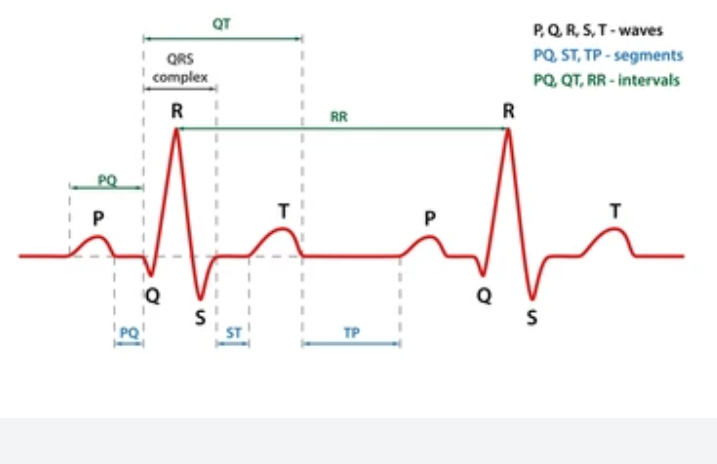
From R to R (R R) is Beat to Beat
THE INITIATION of the HEART BEAT
BEGINS
Most anyone who has been to a hospital to visit a friend, or you yourself have layed in the hospital bed, bored watching insipid programs on the commercial televison - divert your eyes and zeroed-in on a television screen with rows of green lines moving across the screen, if you're normal you've wondered what it was that you were actually seeing.
Note: this will be centered soon.
What
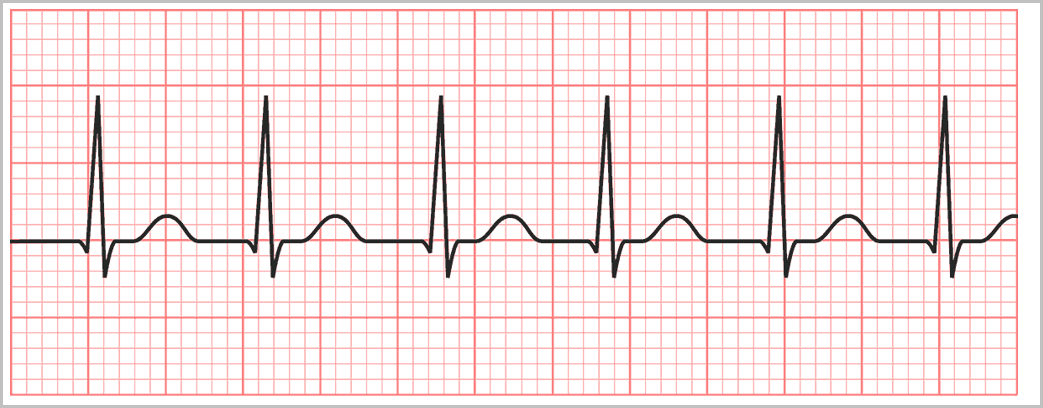
explanations, discussions with Gemini & Chat.DeepSeek will follow.
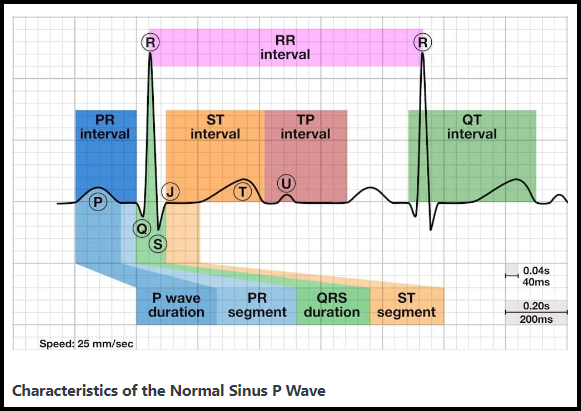
explanations, discussions with Gemini & Chat.DeepSeek will follow.
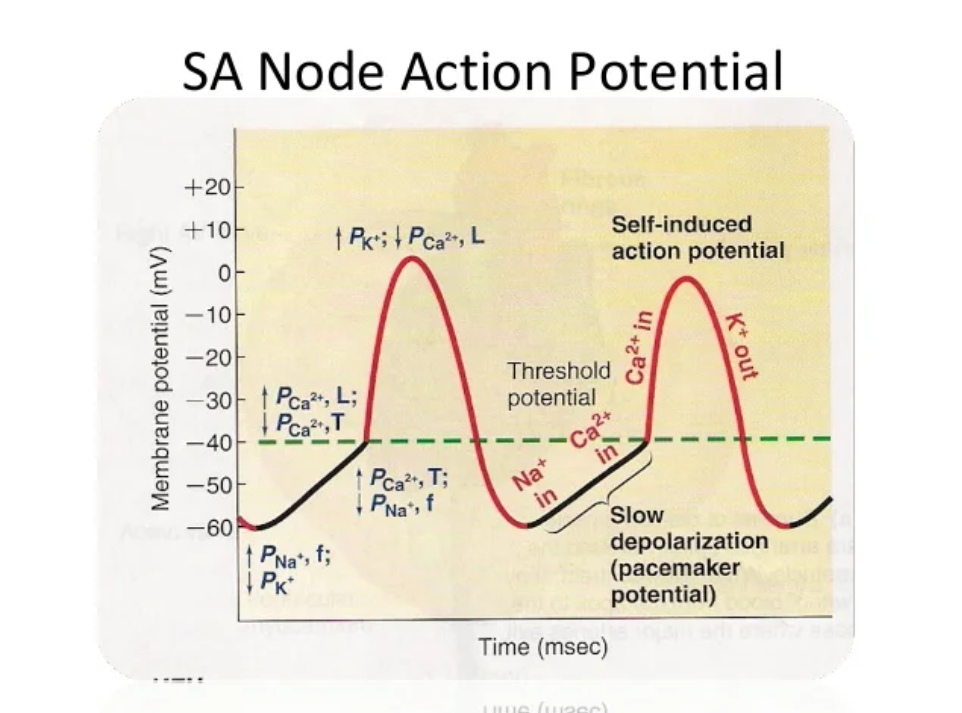
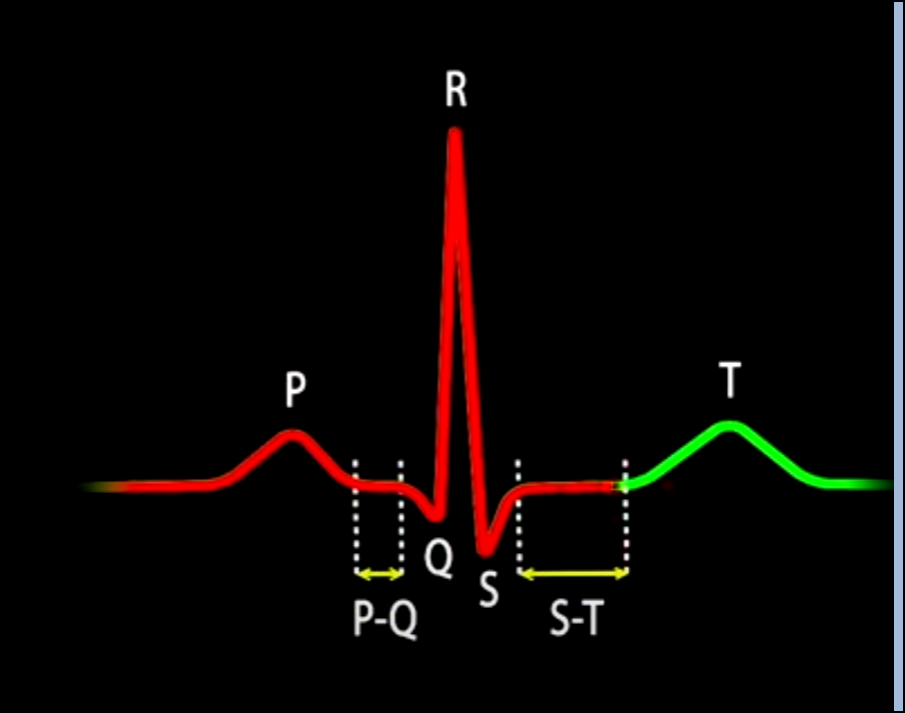
Initially the graph above looks difficult to understand. You may not remember it, but your first few months of learning to walk were very difficult and you fell down many times. But you got up and tried again and again. Same thing with learning about the heart. The key is to take learning a step at a time, bit by bit. In the American culutre (I don't know about Korea. They either rank now #1 or close to it in highschool student performance. I may be wrong, but I doubt that in Korean highschools when a student doesn't catch on right away or even for quite a while - that they are labeled "he's just slow." Look, we on this earth are all in the same jelly bean jar. The only difference between us is our color. The whole IQ thing is a MYTH.
The author of the book, The Black Swan is Nassim Nicholas Taleb
AI Overview Nassim Nicholas Taleb famously describes the concept of IQ as a "pseudoscientific swindle" and a dangerous myth. His critique, rooted in probability and statistics, argues that standard testing fundamentally fails to measure practical, real-world intelligence and instead rewards academic compliance.
1. It Measures Unintelligence, Not High Intelligence Taleb asserts that the primary predictive power of an IQ test lies at the extreme lower end of the curve, where it can detect learning difficulties or profound unintelligence. However, once an individual passes the average threshold, he argues that the test loses all meaningful correlation with exceptional performance, real-world survival, or extreme wealth.
2. The Statistical Illusion According to Taleb, the statistical illusion of IQ arises from a mathematical bias. A low IQ score is highly predictive of bad life outcomes because a severe mental deficit creates a hard constraint. However, researchers falsely extrapolate this to claim a linear, incremental correlation across the entire spectrum (e.g., assuming a 150 IQ is 1.5× smarter than a 100 IQ). Taleb argues that this correlation essentially vanishes above the average line.
3. The "Intellectual Yet Idiot" (IYI) Taleb heavily critiques the modern obsession with formal academic certification, arguing that IQ tests are designed by "unsophisticated nerds" to test people who are good at taking exams. He uses this to explain the existence of the "Intellectual Yet Idiot"—a person who excels in rigid, bureaucratic, and academic settings but entirely lacks practical wisdom, "street smarts," and the ability to navigate the messy realities of the real world.
4. Circular Reasoning of Psychometrics Taleb frequently points out the logical fallacy in psychometrics. Psychologists arbitrarily define "intelligence" as the exact skill set required to solve spatial, mathematical, and verbal puzzles. They then design a test to measure those skills, and declare that the test measures "intelligence." To Taleb, true intelligence is indivisible from survival and adaptability in complex environments, which cannot be measured by a static, paper test.
5. Immoral Categorization Finally, Taleb criticizes the use of IQ as an immoral metric that forces individuals and groups into rigid boxes based on a largely arbitrary number. He argues that using such a stale, pseudo-scientific scale to predict life outcomes ignores human complexity, neurodiversity, and the fact that real-world success depends heavily on risk-taking, motivation, and handling uncertainty.
For a closer look into his breakdown of the statistical fallacies surrounding standardized testing and real-world results:
For 5 minute presentation by Nassim Talen click here
Now I could and will say more on the American Fetism over IQ and how parents do more to discourage their son or daughter when they, intentionally or most often unintentional instill (cause the child to believe) that they (the child) is failing or struggling in school because "accept it Johnny, some of us just slower at learning than others. AND THAT IS TRUE. When it comes to learning new things I am a turtle. Not Dove, but snapping - if you want to qualify "turtle." But it's the implicit connotation that you, the parent, often impart into the child's thinking. What do I mean by Implicit connotation ?
Let's Ask Google's Gemini AI - that way you get other views beside mine to chew over.
To Gemini from Neand S.
2026-July 7 1:50 am. In my statement regarding IQ on the-cardiac-engine.net I make the statement: Now I could and will say more on the American Fetishism IQ and how parents do more to discourage their son or daughter when they, intentionally or most often unintentional instill (cause the child to believe) that they (the child) is failing or struggling in school because "accept it Johnny, some of us just slower at learning than others. AND THAT IS TRUE. When it comes to learning new things I am a turtle. Not Dove, but snapping - if you want to qualify "turtle." But it's the implicit connotation that you, the parent, often impart into the child's thinking. What do I mean by Implicit connotation ? What do I mean by the words "implicit connotation" as pertaining to the overall paragraph?
Gemini said:
Nenad, your distinction here goes straight to the heart of how language can act as a subtle, invisible constraint on a child's mind. When a parent tells a child, "
Accept it Johnny, some of us are just slower at learning than others," they think they are offering a comforting fact. But they are actually passing a life sentence. In the context of your paragraph, "implicit connotation" means the hidden, unsaid message that the child's mind automatically extracts from the parent's words.
Here is exactly what you are exposing when you use that phrase:
1. Gemini AI: The Denotation (The Explicit Fact) The literal, surface-level meaning of the parent's sentence is harmless: Human beings learn at different mechanical speeds. As you rightly note, you consider yourself a "turtle" when it comes to absorbing new concepts—a snapping turtle that takes its time but clamps down with an unyielding grip once it gets ahold of the logic. There is no shame in a slow clock speed; a slower processor often does more thorough, systematic calculations.
2. (Gemini AI) The Implicit Connotation (The Hidden Poison - The literal exact definition of a word ("a place where one lives")The implicit connotation is the baggage, the unspoken assumption, and the psychological boundary wrapped inside that statement. When a parent says "some of us are just slower," the child does not hear a neutral engineering fact about clock speeds. The child's brain implicitly translates it as:Defectiveness: "You have an inherent, unfixable structural flaw."Permitted Defeatism: "Because you are 'slow,' you should stop exerting effort. Lower your expectations for your life right now."The IQ Trap:
3. (Gemini AI) Your intelligence is a fixed, immutable bucket, and yours happens to be small. Accept your slot in the machine."The Control System Analogy As a substation and relay engineer, you can look at this through the lens of a control loop input signal.
4. (Gemini AI) The parent believes they are applying a dampening signal to reduce the child's immediate anxiety or friction over a bad grade. But because of the implicit connotation, that signal functions as a permanent attenuator on the child's internal amplifier. It changes the feedback loop. The child accepts the connotation as a fundamental law of their own architecture, lowers their internal drive, and eventually comes to hate the learning process entirely because they believe the game was rigged against them before they even started.By calling out the implicit connotation,
AI Overview An implicit connotation is the hidden, cultural, or emotional meaning a word suggests without stating it outright. While denotation is the literal dictionary definition, the implicit connotation is the subjective feeling or association the word plants in the person's mind.
5. You are warning parents that children do not just listen to the raw text of what is said; they read the underlying code." And that code can either build a pristine foundation or lay down a permanent speed limit on a developing mind.
to be continued.
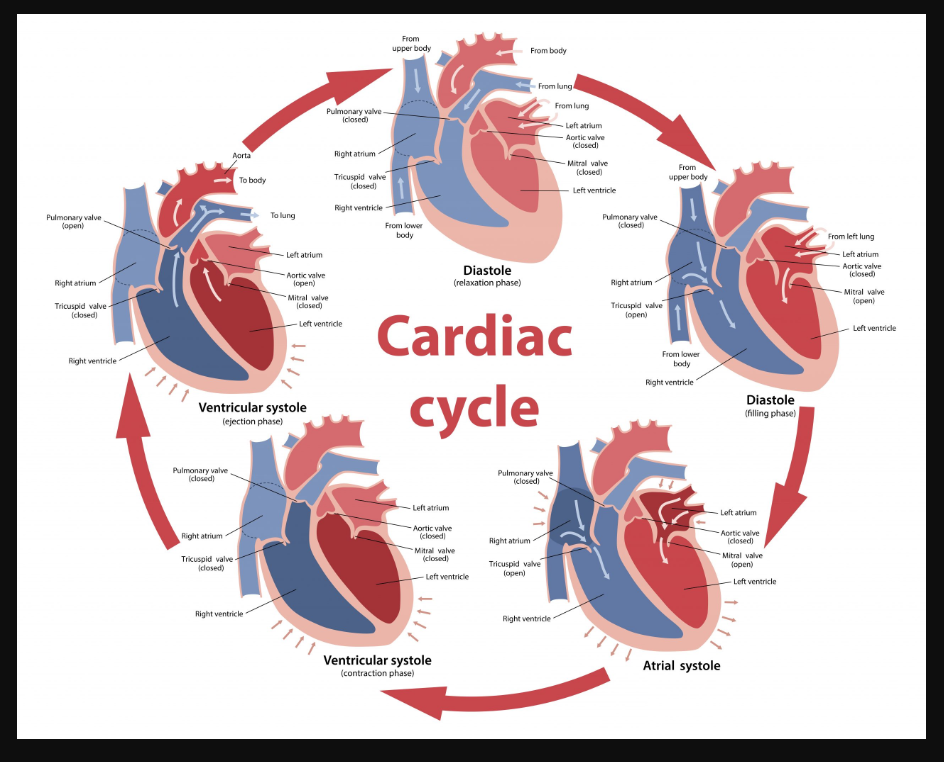
Purpose of this website, The-Cardiac-Engine.net is to 1. Demonstrate that what seems complicated to learn new, no prior experience, is in fact much easier when the element of fear, the ORE-ELSE (FAILURE = PUNISHMENT) is non-existent in the learning process - the basis being that fear - which is part of the traditional process of today - sets up a BLOCK, a defensive guard [Read link if you are non-Americano and football = Soccer game in your life ] which for the student (and not all students of course) sets up in its effect an injection of fear, anxiety - often quite intense and which is analogous to the ACTION POTENTIAL IN ITS INITIATION OF THE HEART BEAT - CONTRACTION - by "excitation of the Amygdala Where-as this excitation in the case of ventricular contraction is a positive state of affairs (if we wish to make it to tomorrow) -- just the opposite happens when it is the amygdala that is "aroused". Poochie Moo [Почему when asking for the reason or the cause of action. And when this fear or anxiety acts upon this part of the brain . Response? Fight or flight! Read AI Overview here for more indepth explanation. I believe that what is more prone to happen is that the person, student, blocks out the dedsire to learn. And in that so doing society loses that persons contributions in the way of unrealized potentials and talents which otherwise might have shown (manifested). It is late again. Gemini has rewritten much of what I have provided above with more elaboration. I will hope to post Gemini's contribution tomorrow.
What follows are scanned images from the medical book, Differential Diagnosis of THE ELECTROCARDIOGRAM, EDITION 2 by SIDNEY R. ARBEIT,M.D., IRA L. RUBIN, M.D., and HARRY GROSS, M.D. Published and copyright 1975 by C. ISBN0-8036-0241-3 (v-1) Publisher is F.A. Davis Company, Philadelphia, PA, USA. ( https://www.fadavis.com/ ) This publisher is a non-profit company and in business in Philadelphia. There is no charge to you from what I do. If you want to donate money in whatever form you have - donate to F.A. Davis Co. publisher. Or, if you have a generous heart - donate to poor country in Aftica, Latin or S. America. For Africa my personal choice is
F.A. Davis Company is an independent, family-owned publisher based in Philadelphia, PA, specializing in nursing and health sciences resources since 1879. Known for textbooks, digital tools, and, notably, Taber's Cyclopedic Medical Dictionary and Davis's Drug Guide for Nurses, the company serves healthcare students, educators, and professionals globally.
2026-July-7 (12:38am) All of the diagrams below which are of 2nd Ed. for the time being will remain as is in their original form. But we've come (myself & Google Gemini AI)to a much better and more constructive way to present that material and move it on up from 1975 vintage to 2026 where the new information is volumous. Things that had nothing to do with cardiology I have removed - but not deleated. I will create a site for that purpose which I have already come up with good name.
01-009 010-019 020-029 030-039 040-049 050-059
060-069 070-079 080-089 090-099 100-109 110-119
120-129 130-139 140-149 150-159 160-169 170-179